Home Blog Page 658

What is Web Hosting?

Web hosting is, at its core, the process by which your website is stored. This means that your website and all of its content will be stored on a computer somewhere on the internet. When someone types your website name into their browser to visit your site, the computer responsible for storing your site dispatches that information to the visitor’s computer where it’s displayed in the browser so they can see it. Hosting is not just about displaying your website, though. It also entails facilitating communication between your site and the internet at large. This is especially important for people visiting your site from other countries. Since the internet doesn’t recognize borders, a visitor from Brazil may be viewing your site from a computer located in Brazil. Your computer, however, may be sitting in a data center in the United States. Web hosting services are responsible for ensuring that the two computers can “talk” to each other.

Shared Hosting

Shared hosting is the most basic type of hosting service available. When you use this type of hosting, you are sharing your site and the computer that stores it with other people via the internet. This is a cost-effective option and is perfect for smaller businesses that don’t have big hosting needs. Pros – The major pro of shared hosting is cost. This is a very affordable option, making it a good choice for small businesses or startups on a tight budget. Another pro is ease of use. Since this option comes with a one-click installation and configuration, you don’t have to be a tech expert to set up your site and get it online. Cons – The biggest con associated with shared hosting is a lack of scalability. Since you are sharing your site with other people, if their sites experience a sudden surge in traffic or are hacked, your site may experience issues as well. Another con is security. Since your site is on a virtual server with other sites, it may be at a higher risk of being hacked.

All Things Web Hosting – What You Need to Know Before You Buy

Let’s face it, the internet is a dynamic place. If you are running a business in any capacity, you know this to be true. Any business that has an online presence is always evolving and trying to stay ahead of the game. What works today won’t necessarily work tomorrow. Keep up or fall behind. It’s that simple, really. If you want to stay relevant as a business and compete with other businesses on the same playing field, then you need to keep moving forward too. That being said, if you are reading this article right now, chances are good that you need new web hosting services for your business. There are many different ways to host your website and numerous pros and cons associated with each option. Depending on what type of business you have, the needs of your customers, and other factors specific to your situation, one option may be better for you than another.

What is Web Hosting?

Web hosting is the service that allows your website to be accessible to users across the globe. If you have an e-commerce site, web hosting is what makes that possible. Your hosting company will maintain servers that store your website’s content, including images, videos, data, and more. Depending on the type of hosting you choose, your host may also maintain your site’s code. Hosting companies typically charge a monthly fee for this service. You’ll typically see three different types of hosting services discussed in the web hosting marketplace: shared hosting, virtual private servers (VPS), and dedicated servers. Shared hosting is the most basic type of hosting plan available. With this type of plan, your website will be hosted on a server that is also hosting other websites. This type of hosting is generally affordable, but it comes with a few drawbacks. For one, it’s not uncommon for websites hosted on the same server to experience a bit of downtime now and then. Shared hosting isn’t meant to be used for heavy traffic or high-traffic websites.

VPS Hosting

If you’re looking for a hosting solution tailored for ecommerce, VPS hosting may be the best option for you. VPS hosting can be thought of as “shared hosting for businesses” — it’s a great way to get more out of your hosting resource with less risk of downtime. Many businesses use VPS hosting to host multiple websites for marketing purposes. If you’re hosting multiple websites, VPS hosting gives you more control over how your data is stored and where it’s located. VPS hosting is great for small businesses or ecommerce websites that don’t need a ton of resources but still need a reliable hosting option. VPS hosting allows you to have your own dedicated resources and control your own data, but you’re sharing a server with other businesses so you’re not responsible for 100% of the server’s resources.

Cloud Hosting

Cloud hosting is similar to VPS hosting in that you have dedicated resources, but with cloud hosting, you’re sharing those resources with a group of customers. Cloud hosting is a great option for businesses that are growing — you can easily scale up your resources as you need more power. Cloud hosting is also great for companies who don’t want to worry about server maintenance. With cloud hosting, you’re letting the experts handle all of those details for you. Cloud hosting is a great option for businesses that need a ton of resources but don’t want to pay for them upfront. Cloud hosting is typically billed on a monthly basis, so you don’t have to invest a ton of money up front. Cloud hosting is also great for businesses that want to scale up their resources as they grow.

Dedicated Hosting

Dedicated hosting is the most powerful hosting service available, but it’s also the most expensive option. Dedicated hosting means you’re the only customer on a server. That means you have unlimited resources at your disposal. You’re only limited by your imagination. Dedicated hosting is best for ecommerce websites with a high volume of traffic or a ton of data. Dedicated servers are ideal for websites that rely on databases or websites that use a lot of bandwidth or are image-heavy.

Conclusion

Web hosting is an essential component of a successful online business. It allows people to visit your website through their browser, whether they’re accessing the internet through a desktop computer, laptop, tablet, or other device. There are a few different types of hosting available, ranging from affordable shared hosting to more robust offerings like VPS and dedicated servers. Before you select a web host, be sure to consider each company’s reliability, data center location, pricing, terms and conditions, available plans, and customer service reputation.

5 Tips For Making Money By Blogging

Many people start blogging because they want to make some money. If you’re one of those people or have never had success making money by blogging, here are 5 quick tips to help!

  1. At Least 5 Posts A Week! – More content generally means you’ll have more visitors. More targeted visitors means you’ll have more ad revenue generating opportunities.
  2. What’s Your Interest? – Blog about something you’re interested in or knowledgeable about. Or tell a story about a project you’re working on. Renovating a house? Write about it! Training for a marathon? Write about it! If you’re not interested in your topic, that’s going to be transparent in your writing.
  3. Writer’s Block? – Use Google’s Keyword Tool and Google Trends to learn what people are searching for and craft your posts around those topics relevant to your blog.
  4. Promote Products You Know About – People would rather read an honest review from someone currently using a product. Or at least try to find a product that is similar to your blog’s overall topic. If you have a blog about being a mom, promote children’s products or companies!
  5. Be Patient! – You’re not going to make money overnight. Keep at it.

How to verify site ownership with Google

This article describes how you can verify website ownership with Google. To use various Google services with a particular domain, you must first verify that you have control over what you claim to own.

Before you can verify site ownership with Google, you must set up a Google Search Console account for your domain. To do this, please visit https://search.google.com/search-console/welcome.

Verifying site ownership

There are several methods you can use to verify site ownership with Google.

You only need to use one of the following methods. You do not need to follow all of them.
Method #1: HTML file upload

You can upload a special HTML file to your site to verify site ownership. For information about how to do this, please visit https://support.google.com/webmasters/answer/9008080#zippy=,html-file-upload.

Method #2: HTML tag

You can include a special <meta> HTML tag in a specific site page to verify site ownership. For information about how to do this, please visit https://support.google.com/webmasters/answer/9008080#zippy=,html-tag.

Method #3: DNS record

You can add a TXT or CNAME DNS record to verify site ownership:

  • Use a CNAME record to verify a subdomain (for example, test.example.com), or a domain that is itself defined with a CNAME record.
  • Use a TXT record to verify any other type of domain, such as your primary domain (for example, example.com). This is the more common scenario, and is described below.

To add a TXT record in cPanel, follow these steps:

  1. Log in to cPanel.
    If you do not know how to log in to your cPanel account, please see this article.
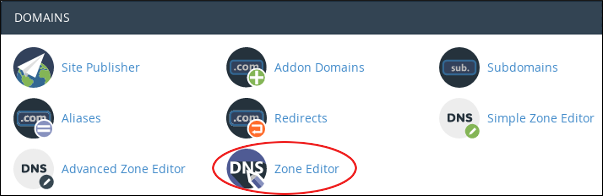
  2. In the DOMAINS section of the cPanel home screen, click Zone Editor:cPanel - Domains - Zone Editor icon
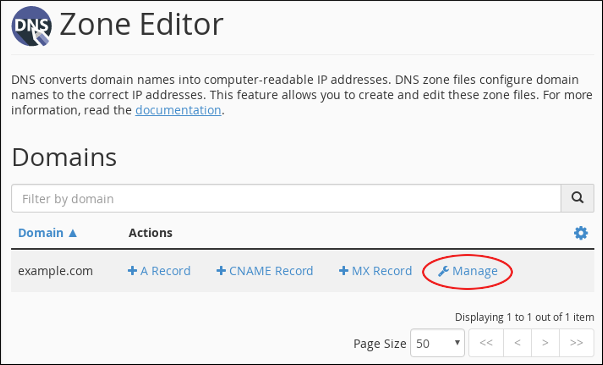
  3. Under DOMAINS, locate the domain for which you want to add the TXT record, and then click Manage:cPanel - Zone Editor - Manage domain
  4. Next to Add Record, click the down arrow, and then click Add “TXT” Record:cPanel - Zone Editor - Add record
  5. In the Name text box, type the fully-qualified domain name (FQDN) for the record (for example, example.com).
  6. In the TTL text box, type the time-to-live value in seconds.
    If you are unsure of the value to specify, type 14400, which is four hours.
  7. Confirm that the Type list box is set to TXT.
  8. In the Record text box, paste the unique TXT record value that Google Search Console displays for your account.
  9. Click Add Record. cPanel adds the record.
  10. In Google Search Console, click Verify. Google checks that the unique value matches the TXT record.
Method #4: Google Analytics tracking ID

You can use Google Analytics to verify site ownership. To use this method, you must have a Google Analytics account configured. By including your unique tracking ID in your website pages, you prove that you control the site. For more information about Google Analytics, please visit https://marketingplatform.google.com/about/analytics.

More Information

For more information about Google site verification, please visit https://support.google.com/webmasters/answer/9008080.

What Is a Fully Qualified Domain Name?

Who runs the world? Domain names! Domain names literally put names on the internet. They help us identify websites and access them easily. But do you know what a fully qualified domain name (FQDN) is? In this post, we’ll go over what FQDNs are, how they work, and some common uses for them. We’ll also show you how to create one for your own website. Let’s get started!

What is a Fully Qualified Domain Name (FQDN)?
A Fully Qualified Domain Name (FQDN) is a domain name consisting of three parts: the hostname, the domain name, and the top-level domain. The hostname is the specific computer or device on the network that you want to use the FQDN for. The domain name is the section of the FQDN that uniquely identifies your network. The top-level domain is the highest level of classification for domains and is assigned by ICANN. For example, when you type “www.google.com” into your web browser, “www” is the hostname, “google” is the domain name, and “.com” is the top-level domain.

Different computer types use different terminology for FQDNs like network names or full computer names.

Why should I use an FQDN?
FQDNs indicate unique addresses on the internet. If you don’t have an FQDN, you don’t have an accessible website. They’re required for installing SSL certificates, imperative to the security of your website.

Apart from having an accessible website, FQDNs are also useful to have a discoverable computer on an internet network, like when you need to access a computer remotely. This is common in an office to track a computer’s activity.

Also, FQDNs help you access domain services like FTP (File Transfer Protocol) and email. For example, if you want to connect your domain name’s email to an email app on your phone like Gmail or Apple Mail, you need to know the FQDN for the mail server, which is typically something like “mail.yourdomainname.com.”

Here is an example of an FQDN:

www.tremhost.com
mail.tremhost.com
ftp.tremhost.com
How to find your FQDN
If you’re not sure how to find your FQDN, please review the following links:

Find your FQDN for Windows OS (operating systems).

Find your FQDN for macOS.


When you generate a domain name, it should contain three parts. The first part is the hostname which identifies the specific computer or device on your network that will be using this FQDN. The second part of an FQDN is the domain name and it uniquely identifies your company’s network. Finally, there is the top-level domain (TLD) which classifies domains as either generic or country-code TLDs such as .com for commercial purposes. If you need help viewing any of these components within your own FQDN contact our support team today!

At 27 years young what are the top 3 things you can do before you turn 30 to be able to say at 50 I have made it in life?

Age 27: start building small automated businesses that give passive income. Increasingly more each year. Fail in many, succeed in some.

Age 28: find true love. don’t take chances in love. seriously seek, find true love, you know… The one you will marry and know she’s the special unique one who will be with you the rest of your life… Happy together. Have kids, build a home and have a happy joyful meaningful life.

Age 29: maintain and grow the business. Sustain and build the relationship.

Age 50: Kids grow up into their teens and mid twenties happily and without ever worrying about not having enough pocket money while in their youth.

Able to let parents live a comfortable happy life without worry about not having enough retirement money to last their entire lives.

Being able to be together with my wife happily in love, seeing the world together and watching movies, dramas together.

Possible because of our businesses we built for years which is by then fully automated, giving us the privilege of “without worrying that time in work means sacrifice for time in life.”

In my mid thirties, so far so good.

Have extremely harsh falls and also extremely lucky breaks…

No longer the fearless teen who thrives on extreme speed and without a care for sports injuries…

Grew up to be one who prefer safety and be careful not to become injured after realizing the body in it thirties doesn’t recover as fast and well in teens.

Cherish love and family, over infatuation and self centered ambitions. Store enough resources to be able to foot unexpected health expenses and safeguard catastrophes…

To be able to live a life where I have given those I love happiness and in turn given smiles, joy and laughter.

I no longer want to conquer the whole like the wide eye teenager I was. I seek to conquer myself, not to let ego get over my head when success comes and not to let disappointment kill my confidence when disaster strikes.

Endure and life will continue.

Preserve and the frowning black clouds will part for the Sunny smiles to shine again.

Always amazed with life. The more I live it, the more amazing this given time seems to be.

What are the best methods to relieve stress?

Adrenaline used to be for escaping tigers. Today, it’s mostly for fun. Rollercoasters, fast cars, the thrill of our sports team winning at the last second. Those are dosed experiences.

A question I ask myself is: Are we still dosing? Sometimes, I feel like I’m running on adrenaline 24/7. I’m injecting myself, of course. It’s an addiction.

When I wake up and check my portfolio, I start buzzing. I reply to five people on WhatsApp. I think about 17 things I wanna do, and by the time I leave the shower, I’m already behind in my mind. Write a post. Quick! Inhale lunch. Check the phone again. More adrenaline! Emails! Calls! More writing. Fasterrrrrr….aaaargh!

When you work from home, you don’t need adrenaline. When your phone rings and it’s a stranger, you don’t need adrenaline. These are not dangerous situations. But if you’ve already chosen to be frantic, it doesn’t matter, does it? You’ll do everything in a frenzy, even if frenzy is rarely required.

It is not a privilege we’re used to, but it’s one we must learn how to handle: We can choose our stress level. There’s good stress, and there’s bad stress — but you are not obligated to give in to either.

You can choose not to be excited, and you can choose not to be rushed.

When I put my phone where I can’t grab it from bed, I wake up differently. I notice the light, stretch my limbs, and feel the warmth under the blanket. I sort my thoughts for a bit. I remember to not chase down the first mental alley. I drink water. I get up. I open the window. I go to the bathroom, wash my face, and get dressed.

By the time I first touch my phone, I’m in a different mindset. It only took five minutes, but I feel settled. Ready. I took care of myself first. I said no to the adrenaline.

This train can derail at any time. If I check the news too early, I ride the rollercoaster again. If I react to some email I get, I’m right back to hyper-speed highway. It’s precious, our state of calm. We must protect it.

Sometimes, you want to be excited, but of all the best days you remember, how many were adrenaline-fueled ones? A big event maybe, or a holiday full of adventures.

Barring those, adrenaline just means busy without motion. It’s vibration at standstill.

I can feel busy, hectic, and stressed all day, only to realize at 7 PM: It was just a normal day. Nothing crazy has happened. There was no point in sprinting through it.

Throttle your adrenaline. You are in control. Design your day to line up with calm. Choose not to be too excited, and, most importantly, choose not to be rushed.

Unless you spot a real tiger, of course. In that case, take your heels and run for the hills.

What are some tips/life lessons I should know before I’m 30?

I turned 30 two days ago. When I was 18, I thought by 30, I’d have it made.

My 20s were a long, slow grind of realizing “made” does not exist. “Made” is past tense — but you’re never done! The only finish line is death, and, thankfully, most of us don’t see it until we’re almost there.

Instead of the binary made/not made distinction, I now see life as round-based. You win some, you lose some, and different rounds have different themes. There’s a carefree-childhood season, a teenager-trying-to-understand-society season, an exuberant-20-something season, and so on.

At 30 years old, I’ve only played a few seasons, but each round feels more interesting than the last. If that trend persists, I can’t imagine what one’s 60s or 90s must be like. By that time, you’ve seen so much — and yet, there’ll always be new things to see.

Most seasons last longer than a year, and there’s plenty to talk about with respect to the important, defining decade from 20 to 30 alone, but today, I’d like to do something different: I want to share one thing I’ve learned from each year I’ve been alive.

1. You’ll fall down a lot, but life is about getting back up

You must crawl before you can walk. The first time you try, you’ll fall down. But you’ll get back up. You won’t think. You’ll just do it. It’s natural. Getting up is the only way. There is no alternative. Getting up is what humans do.

This is the first literal lesson most of us learn — and that pattern never changes. In everything you do, you’ll have to crawl before you can walk. You’ll fall down countless times, but it’s not the falls that matter — it’s that, every time, you get back up.

2. Talking solves everything

I watched Planet of the Apes the other day. That movie will give you a new sense of appreciation for our ability to speak. At first, all we’ve got is one-word commands. Hungry! Thirsty! Tired! As we grow up, we get so much more.

My favorite quote from Albus Dumbledore is this: “Words are, in my not so humble opinion, our most inexhaustible source of magic — capable of both inflicting injury and remedying it.” It’s true. Words can mend anything. Use your words.

3. The world is big — but there’s always light at the end of the tunnel

When I was three, the hallway of our small apartment seemed huge. The carpet seemed to stretch forever, and the walls were as high as the sky.

We had one of those plastic crawling tubes for kids. It had black and white stripes, like a zebra. I would crawl inside, and, sometimes, I got scared. I felt lost. Even that tiny tube was too big. Where do I go? Forward? Backward? How do I get out of this thing?

Eventually, I learned that there’s always light at the end of the tunnel. All you have to do is keep crawling.

4. Everything you need is in your head

I used to sit on the floor of my dad’s tiny office for hours. I built things. Lego, Playmobil, Duplo train tracks — you name it, I made stuff up with it.

Sometimes, my dad helped me. We made the train go back and forth between rooms, transporting candy. But I was perfectly happy being the master of my own little universe — because I could already tell: There are no limits.

Everything you’ll ever need is in your head. Sometimes, other people will help you get it out — but even if they don’t, it’s all there. Trust in yourself.

5. Life is better when you share it

When I was five, my parents had my sister. At first, I didn’t want a sibling. Who’s gonna get all the attention? “I don’t like her.” Those were my first words.

My grandma took me to the mall to calm me down. We bought two teddybears — one for me, one for her. When I reluctantly gave it to my sister, she held my finger. In that moment, I was cured. To this day, she is family, and that will never change.

It’s easy to get lost in your world. Your life spins around you. Life in general, however, is much broader. Share it. Don’t hog. A lot of things multiply when we divide them. Joy, achievement, laughter.

Our best memories are reflections of the people who were there to see them.

6. When you know, you know

I learned how to read before I went to school. I still remember sitting in a sea of red, plastic letters.

“Apple.”

“Apple!”

“APPLE!”

“MOOOOOOOOM!” I ran around the house for about 15 minutes. Then, I read everything I could get my hands on.

Some things in life are just made for you. When you find them, you’ll know. Don’t ever doubt that feeling — and don’t ever let them go.

7. You cannot find without looking

In second grade, I walked to school every day. It was exhilarating. Ten minutes. Just me and the world. There was so much to see!

Sometimes, my neighbor’s son walked with me. He was a few years older. Right outside our street, there was a cigarette machine. Every time we passed it, he reached into the coin return slot to see if there was any money. One time, he found a bill! 20 Deutsche Mark, or however much it was.

For a long time, I then did the same. Checked every coin slot I passed. Finders, keepers, you know? But in order to find, you first have to look. I’ll never forget that lesson.

8. Goodbyes are hard but necessary

We moved in 1999. I was devastated. My second-grade crush still had no idea I existed. Hello?! I’ve got plans here!

Sometimes, life doesn’t care about your plans — and sometimes, that’s exactly what you need. An unplanned change of plans. It won’t make saying goodbye any easier, but in time, you’ll realize some goodbyes were necessary.

In hindsight, I’m glad we moved a few times while I was in school. It taught me how to adapt and make new friends.

9. Not everyone you don’t like is your enemy

My third grade teacher was an old lady — Frau Blum. She was strict, grumpy, and more of a drill sergeant than a teacher. At first, I thought she was mean and bitter.

Years later, I appreciated every bit of discipline she taught us, especially as the modern classroom seemed to completely unravel as a good learning environment.

Maybe, Frau Blum was just desperate to preserve something she had learned to value as a child: good manners and a sense of duty. I’m grateful she passed some of those values on to us.

Not everyone you don’t like is your enemy. Some people enter your life to prepare you for things you can’t see coming.

10. Believe in things before others can see them

Pokémon took our school yard by storm. All recess long, we were trading cards, playing Game Boy, and talking about the anime. Eventually, our school banned everything. Imagine the outrage!

15 years later, Pokémon Go got more people out of the house than the Super Bowl gets in front of the TV. 20 years later, some Pokémon cards sell for $200,000. It is one of the most successful franchises in history — we always knew.

With Lego, it’s intuitively clear that you must first imagine before you can build. With many other things in life, it’s not — but the same principle applies. Believe in what only you can see, so that, one day, others will see it too.

11. You’re at your best when you’re with friends

In 6th grade, my best friends and I joined the choir. I have no idea why. All we did was goof off. We made fun of the girls, the songs, and each other. We got called out a million times. I’m a terrible singer, but, eventually, going to choir became my favorite thing to do. Not because of the activity — because of the people.

You’re never as good as when you’re with friends. Together, you’ll feel unstoppable.

12. Sometimes, you win only to lose

On the year-end school trip before yet another move, the hormones among 12-year-olds really started flying. We played a game of kiss-or-pass. My crush gave me one. Or, maybe, she only became my crush once she did.

Either way, she left her sweater in our room. It smelled nice. Four boys were swooning. We argued about who she’d pick. I don’t remember how, but she ended up being my girlfriend for a few sweet weeks of summer. We held hands in school. We went to the movies.

After the move, she came to visit one time. Then, it quickly fell apart. Even a 30-minute drive can be too far for clueless 12-year-olds.

Sometimes you win, sometimes you lose. But, sometimes, you lose what you have won right afterwards. Those times stink — but those too are necessary for your growth.

13. Never hide your power

One time in history class, my teacher asked for the name of the big, wall-covering carpets you’d see in places like the Palace of Versailles. No one knew the answer, except me — I had heard it on an episode of King of Queens.

I raised my hand: “Gobelin.” Our teacher was beaming. “That’s right! Great!” My classmates thought it was great too: “Ooohhh, go-be-liiiiiiin, look at Mr. Smartypants!” They laughed their asses off at my (correct) French pronunciation.

Being a good sport about it, I laughed with them, but, deep down, that incident taught me: Never hide your power. The world wants you to be cool, not smart. But if you’re smart, you’ll win. So don’t try to be cool instead of being smart.

Whatever power you have, use it. Do not let the world bully you into hiding your strength.

14. Everything is art if you bring your true self to it

I hated art class. I sucked at drawing, painting, and crafts. Mostly, I hated it because we all had to do the same thing. “Paint a wave.” “Use different-colored tracing paper.”

Actually, we were free to use our imagination. The teacher gave us constraints, not goals. I just didn’t see it.

I did, however, spend hours doodling on my pencil case, sketching anime characters, and turning my planner into some kind of Harry Potter book of worship.

It was easy to express my creativity in some ways but not others. Eventually, I learned that everything has room for your ideas. You just gotta bring them — and then figure out how you can contribute to the task at hand.

15. It pays to be early

In 2006, I discovered football freestyle. The community was tiny but growing fast. I spent hours practicing each day and, for about 15 minutes, I was world-class.

I also uploaded some animated music videos I made on Youtube. Some of them got 100,000+ views. Eventually, the channel was shut down for copyright issues.

I got a lot of GamerScore on Xbox too. I ranked relatively high compared to the world’s number one. Maybe top 200 or so.

The lesson here is that as long as you’re early, you can achieve a lot with effort alone. I wasn’t talented enough to be a hall-of-famer in any of these things — but if I’d stuck with them, they all could have been real careers.

Don’t stop dabbling. You never know when you’ll strike gold.

16. You can fall in love with places, not just people

Our 10th grade school trip was to Munich. It took me all of ten minutes after getting off the bus to declare: “One day, I’ll move here!” The next year, I came back for an event. Three years after that, I did a 6-month internship.

Each time I visited, I loved the city a bit more instead of less, and so, in 2016, I finally moved to where I belonged. It feels nice to belong somewhere.

17. It is your job to insist on learning — the world won’t force you to

My state ran an experiment: They would allow kids to drive at 17 instead of 18, but each time they drove, an adult would have to sit next to them.

I insisted on driving wherever we went. Five-minute drive to the station? I drive. Quick bakery run? I drive. It was more hassle for my parents, but, most of the time, they let me drive. They thought it was important to keep practicing — and they were damn right.

A lot of my friends were lazy. They either didn’t drive a lot after passing their test or didn’t even bother to take it before turning 18. As a result, many of them were insecure drivers for the first year or two — but then they had to face their insecurities alone.

When I turned 18, I went to our garage, got into our car, and drove myself to school like nobody’s business.

It’s up to you to keep learning. Insist on it. School won’t last forever, and the world won’t force you to keep practicing — but if you don’t, you’ll fall behind just the same.

18. Know when to quit

In 2009, I gave up on football freestyle. I wasn’t talented enough, my knees were shot, and the career prospects weren’t all that great. It also just wasn’t as important to me as other things.

It is incredibly hard to give up on something you love — especially if it loves you right back. What in hindsight looks like an obvious endeavor to kill is, often, in the moment, a difficult, not-at-all clear decision — but it might still be a decision you must make.

Know when to quit, and don’t hesitate to give up on what truly won’t work.

19. If you want to know how far you can go, you must go farther than you’ve ever gone

I didn’t feel very challenged in high school. I pretty much did the minimum and got straight As. In college, that changed — and fast.

We had seven exams in our first semester, each of which determined 100% of that subject’s grade. They were all topics I’d never studied before, or at least not in such depth. Between advanced calculus, accounting, and deliverable programming homework each week, I was drowning.

It didn’t feel good. I was overwhelmed. I clung to my friends, who felt the same. We studied from 7 AM to 11 PM each day. Eventually, we all passed our exams, and we learned: You can go somewhere you’ve never been and still return home alive.

The only way to find — and raise — your limits is to go beyond them. Do it.

20. Don’t override your principles

In 2011, I moved into a new-build studio. Before, I’d lived in a run-down, cockroach-infested, the-shower-requires-coins-to-work situation — with roommates I didn’t know. The rent was 50% more, but my quality of life rose by at least 300%. Everything was better, and the part I enjoyed the most was living alone.

I should have realized right then and there: I am meant to live alone, and I should never cheapen out on rent as long as I can afford it. Of course, I went back to living with roommates for another 7 years. That was a mistake.

You can’t know what your principles are before you find them, but when you do, do yourself a favor and don’t try to outsmart yourself. Don’t override what you know deep down in your gut will always, universally be true for you. Stick to your principles.

21. You don’t have to do things the way other people do them

There’s always, always room for you to invent a completely new solution. Our first three semesters had a set schedule. After that, we could pick electives. But it was only a suggestion. There were no hard rules saying we had to do our exams in that order.

The third semester was the most brutal, so I did some electives first. I also postponed the two hardest exams — Math III and Statistics II — which I ultimately ended up “outsourcing” to my exchange in the US, where I could piece the credits together with multiple, easier classes. I returned home with 2 As in exams I barely might have passed otherwise (in fact, I’d failed Math III once before).

There are no rules. Make up your reality, and then fight to see it come true.

22. Travel is not the answer

I spent most of my savings on trips while studying abroad. I also had a rich friend who invited me on the trip of a lifetime. Within 14 months, I went to more than half of all US states, Canada, Mexico, Japan, Korea, Australia, Sri Lanka, and a bunch more places in Europe. It was insane.

It gave me a sneak peek of the freedom I knew I wanted to have, but it also taught me two lessons:

  1. Travel is a full-time job — and if you have another, you’ll have two.
  2. Travel alone will not make you happy.

Since I came back, I never had the same desire to travel the globe. It’s nice. There are some places I wanna see. But indefinite travel pales in comparison to a solid, challenging routine and five lifetime friends.

23. Most dream jobs are born out of dreams

In 2014, I scored an internship at BMW M. They make my dream cars, and so it was a dream job. I lived in Munich. I made new friends. It was summer. I got to drive cool cars and go to insane events. It was the perfect six-month stretch of life.

By the end of it, however, I realized the best thing about these cars was to drive them. They practically sold themselves, and there wasn’t much to do or learn in my department — sales. That’s when I decided: I will create my own job.

Try to get the best job you can imagine. If you do and still find it unfulfilling, you’ll know: Your dream job is a job you must dream up. Don’t be afraid to make your own shoes if none of the ones society offers fit.

24. No one will do it for you — “it” is anything

What I had seen glimpses of in college and my internship became a hard, full-fledged reality in 2015: You must take 100% responsibility for anything you want out of life.

If you want to have great sex, you must work with your partner until it’s great. If you want to get ripped, you must do the workouts. If you want to make money in a certain way, you have to figure out a path to get there.

In my case, no one would make me an entrepreneur. I registered a business and became one. Then, I figured out how to do it — one day at a time, through many failures and gigs I ultimately didn’t like. Until, one day, I had a system that worked and allowed me to go after what I want the way I want it.

You are your own best asset. You don’t control everything, but you’re 100% responsible either way. Accept it so you can make real progress instead of complaining.

25. Your space should give you room to think

In the US, I lived in a tiny, 90 sqft room. It showed me: You don’t need much. I learned more about minimalism, and when I returned home, I threw away a ton of stuff.

Every item you own becomes a mental and emotional attachment in your brain. Even if you forget about it, it’ll still weigh on your mind. Letting go is liberating.

The best part about physical space, however, is that it provides — as my roommate taught me in the first semester of our master’s — literal “room to think.”

Minimalism isn’t about living carefree, it’s about creating space for everything you care about the most.

26. History doesn’t repeat, but it rhymes

When I fell down the bitcoin rabbit hole in 2017, I saw many parallels to the early internet. I saw each generation had its own way of doing things, and, when it came to finance, blockchain could be ours. I spent a lot of time learning, understanding, and failing in that space, both financially and work-wise.

Especially as the price went down, everyone and their brother thought I was wasting my energy. Four years later, both the price and social acceptance look different.

Your life is a unique journey across a small patch of history’s tapestry. It’ll provide you with a singular viewpoint of your time. Others have other viewpoints, so they’ll doubt you when you recognize a pattern our ancestors have documented before. Ignore them.

Study history, and when you feel things click, let them click fully into place.

27. You’ll lose friends, but you’ll still have friends

I’ve lost several friends over writing in public. Some were offended by articles that weren’t about them. Some thought I was arrogant, and some I ditched because they badmouthed me behind my back.

Even if a relationship fades, its contribution to our life never ends. After all, we’ll benefit from the role that person played forever. As you get older, you’ll lose touch with some people you hoped would stay lifelong friends. That’s sad, but others will enter the picture.

You’re never really alone, even when you most feel like you are. Look around you, and connect with who actually wants to be in your life at any given time. So yes, you’ll lose friends — but you’ll also always have friends.

28. Take chances while you can take them

Two of my favorite musicians died before I ever saw them live. It’s not that I couldn’t — I just thought I had more time. We tend to think so for many chances in life, until they’re gone and we must concede: We should have taken them while we could.

I started going to more concerts with my sister, and I hope we’ll be able to continue this tradition for a long time to come.

29. If you try hard enough, you can adapt to anything

No one expected 2020 to go the way it went. No one. Within weeks, we had to re-learn how to work, how to rest, how to study, how to parent, how to organize our lives and how to interact with each other. That’s a lot of learning in a very short period of time.

From one day to the next, life 2.0 was uploaded to the app store, and we were all forced to “patch up.” At first, we struggled a lot. Now, we struggle a little less. Things are far from perfect, but, for the first time in decades, we were reminded that our capacity for adaptation is astounding.

You didn’t ask for it. You wish you didn’t have to, and I don’t blame you — but if you try hard enough, you can adapt to anything.

30. Tomorrow can be a good day

If I could leave behind just one sentence, it would be this one: Tomorrow can be a good day.

I don’t know when or how I picked up this particular lesson. It’s probably optimism by osmosis, picked up from being around my wonderful family for about two out of my three decades on this planet.

There must have been about 3,000 instances in which this sentence saved my mood, time, energy, or any other of a million parts of my life, which, overall, pretty much equates to saving my life altogether.

Tomorrow can be a good day.

This is the message I most believe in — and maybe the only one worth sharing. Whether it’s for another 30 years or 30 minutes, I’ll keep yelling it six ways from Sunday: When your boyfriend breaks up with you, your car won’t start, your Zoom won’t work, your grocery store is closed, your doctor says you need surgery, you’re late on rent and your dad won’t fork out 50 bucks, remember that…

Tomorrow can be a good day.

What seemingly nice behavior is actually toxic behavior?

There’s a certain type of person who likes to give gifts.

They will buy/give you nice things without asking. Offer to do things for you or just do them without you accepting. You will think they are really nice people.. until the real person unravels.

You know what the gifts really are?

Collateral.

I’ve come across this a few times in my life, from both male and female culprits. I won’t try to put a label on this type of person, sociopath, maybe? All I know that it’s a very clever trick and very easy to fall victim to.

The gifts are like a carrot on a stick, they draw the person in. Gives a nice impression.

But…

The gifts are just a way for the person to sink their claws in.

Now they have chips to use against you if they ever need it.

They WILL start asking for favours and such in return, because remember that time they’ve done all those nice things for you?

They WILL use you at any opportunity, they now have something over you.

They do not like it if you object to doing what they want. They will make you feel like you’re a terrible person.

Of course, you can’t go back in time now, and untake or undo all of their favours that were inadvertently forced apon you.

Moral of the story here?

Some people do not give gifts to be nice or to make people happy.

Sometimes there can be an ulterior motive lurking, and will be used against you at a later date.

What is the best way to live a happy and successful life?


People often yearn for either happiness or success, but rarely both. It is certainly possible! Before sharing how I have come to live a happy and successful life, I am going to start with my story before I had a turning point.

It was a holiday. My relatives gathered, and we were enjoying the time together. One of my older cousins arrived, and instantly he became the focus of the day. As it turned out, he was admitted to one of the most prestigious schools, and everyone congratulated him. “Wow!,” I said to myself, “attending a great school is such an admirable thing!” As an elementary school student, I formed a strong mental image that associates a good school and praise, and I desired to become like my cousin. I wanted to be the center of attention. A few years later, he got a job at a sought-after company with a large salary, and everyone applauded him once again. Then, another idea came to me: “I want to get a good job and make a lot of money.” As I grew up and saw more successful, respected people, my desire for success continued to grow.

Dreaming about attending a prestigious college, I attended elementary school, middle school, and high school. I dreamt about getting people’s acknowledgement and at the same time worried about not reaching that goal. I was dreaming and worrying, rather than spending time and energy to study. Embedded in my mind, this idea of success became a huge burden and a source of stress.

Many of you must have the same experience. Instead of actually doing the work, your mind wanders elsewhere. You might be thinking about an upcoming travel plan, stressed out over conflicts with friends, family, or coworkers, or worrying about what would happen if things don’t go as desired. Yes, I was constantly worrying about “what ifs”: What if I can’t get an A in this class? What if I do not get into a good school? What if I can’t get a good job? What if people laugh at me or disrespect me?

It was an endless cycle of misery: merely wishing for success, not putting anything into action to become successful, and being unhappy about not reaching my goal. To escape from reality, I mindlessly surfed the internet, binge watched movies, and habitually procrastinated, further worsening my situation.

One day, I heard that meditation would help me be happy and focus and it would bridge the gap between where I wanted to go and where I was. So I embarked on this new journey.

That was true. Meditation was like a GPS giving me a turn-by-turn direction. First, it helped me realize that I was trapped in my mind, which is an accumulation of my experiences. I created so many mental images about success and constantly reinforced them throughout my life, and I was obsessed by them and tormented by them. I had been unable to enjoy my life and the world as is. After seeing and eliminating these invisible chains, I became free from my obsession for success. Through meditation, I escaped from my habits and body, such as my habit of procrastination. Naturally, I became happier without being conditioned to success.

After being rescued from my narrow-minded world–filled with a desire for success and unhappiness, I had many realizations. I realized (not just with my head but with my heart) that I was just wishing for something and complaining. Then, I became determined to work hard to achieve my goals and focus on those goals. This new found work ethic led me to some of the best schools and high paying jobs, just like my cousin. At the same time, without the obsession for success, I have been living a happy life and living in the moment.

I have many friends who attended best schools, have high paying jobs, and are respected in their fields. Few are satisfied with what they have achieved; they continue to struggle to climb higher. They think that once they become more successful, they will be able to enjoy their lives.

No. External conditions do not end human greed. Once we accomplish a goal, we always want to accomplish another bigger goal. That is the human nature. Instead, we need to change what is within us. We need to find happiness within. And without stress and anxiety, we can naturally work hard and be successful.

I hope that many people try meditation to eliminate the self-imposed mental traps to live a happy life and accomplish their goals. I want to help people live a happy and successful life. For that, I am writing this post–not just wishing for it, but putting it into action.