



From the outside, a hosting failover can look deceptively simple. A service slows down, pauses briefly, or—if everything works as designed—continues running without users noticing anything at all. Behind that calm exterior, however, a tightly choreographed sequence of technical decisions is unfolding in seconds or even milliseconds.
Failover events are where hosting architecture proves its value. They reveal whether “high availability” is a marketing promise or an engineered reality.
Failure Is Assumed, Not Unexpected
In enterprise-grade hosting, failure is not treated as an anomaly. It is assumed. Hardware components degrade, disks fail, networks drop packets, power supplies trip, and software crashes. A failover event begins long before something breaks, with infrastructure designed around the expectation that it eventually will.
This philosophy shapes every layer of the stack. Redundancy is built in, monitoring is continuous, and recovery paths are pre-defined. When something goes wrong, the system does not ask if it should respond, but how.
Detection: Knowing Something Is Wrong
The first stage of a failover event is detection. Monitoring systems continuously probe servers, applications, storage devices, and network paths. These checks are not superficial pings; they measure response time, error rates, resource saturation, and service health.
When thresholds are crossed—such as a server becoming unresponsive, a database lagging excessively, or a network route failing—alerts are triggered. In modern environments, this detection is automated and near-instantaneous. Human operators are informed, but the initial response does not wait for manual confirmation.
Speed matters here. The faster a failure is detected, the smaller its impact.
Isolation: Containing the Problem
Once a failure is identified, the affected component is isolated. This step prevents the issue from spreading. A failing server is removed from load balancers, a degraded storage node is taken out of rotation, or a network path is bypassed.
Isolation is critical because many outages escalate not due to the original failure, but due to secondary effects. By quickly removing the problematic component, the system protects healthy parts of the infrastructure from being overwhelmed or corrupted.
This containment phase is largely invisible to end users, but it is one of the most important aspects of resilient hosting design.
Traffic Rerouting and Resource Reallocation
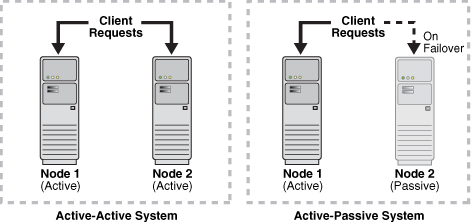
With the failure isolated, traffic must be redirected. Load balancers shift incoming requests to standby or secondary systems that are already running and synchronized. In active-active architectures, traffic simply redistributes across remaining nodes. In active-passive setups, a standby system is promoted to active status.
This transition is where architectural choices matter most. Systems that rely on manual intervention or slow synchronization may experience noticeable downtime. In contrast, environments designed for high availability execute these transitions automatically, often in seconds.
For users, this can mean the difference between a brief hiccup and a prolonged outage.
Data Consistency and State Management
Failover is not just about redirecting traffic. It is also about ensuring data integrity. Databases and storage systems must be kept in sync so that transactions are not lost or duplicated during the switch.
Enterprise hosting environments use replication strategies—synchronous or asynchronous depending on the workload—to ensure that backup systems have an up-to-date view of data. During failover, these replicas become authoritative, allowing operations to continue without data corruption.
This step is particularly critical in financial systems, e-commerce platforms, and SaaS environments where data accuracy is as important as availability.
Recovery Without Panic
Once traffic has been successfully redirected and systems are stable, attention turns to recovery. The failed component is diagnosed, repaired, or replaced. Importantly, this happens without pressure, because the service is already running on alternate infrastructure.
This separation between incident response and service availability is what distinguishes mature hosting environments. Recovery can be handled methodically rather than urgently, reducing the risk of human error and secondary failures.
Providers experienced in high-availability operations, such as Atlantic.Net, design their platforms so that failover is a routine operational event, not a crisis.
Validation and Reintegration
After the issue is resolved, the repaired component is tested and gradually reintroduced into the production environment. Traffic is rebalanced, replication resumes, and monitoring confirms that performance and stability meet expected standards.
This reintegration phase is deliberate. Rushing a component back into service can reintroduce instability. Mature hosting environments treat reintegration with the same caution as initial deployment.
Why Users Often Never Notice
When failover is engineered correctly, users may never realize it occurred. Requests continue to resolve, transactions complete, and applications remain responsive. This apparent invisibility is the hallmark of effective high-availability design.
It also explains why failover capability is difficult to evaluate from the outside. Its success is measured by absence of disruption, not visible action.
Failover as a Measure of Hosting Quality
Failover events are stress tests for hosting providers. They expose weaknesses in monitoring, automation, architecture, and operational discipline. Providers that cut corners may advertise uptime but struggle when real failures occur.
Enterprise-grade hosting treats failover not as an emergency feature, but as a core operational process—tested, refined, and executed regularly. For businesses running critical workloads, this capability is not optional. It is fundamental.
Conclusion
A hosting failover event is not a single action, but a sequence of coordinated responses: detection, isolation, rerouting, data protection, recovery, and reintegration. When these steps are engineered and automated properly, failure becomes manageable rather than catastrophic.
For growing companies and enterprises alike, understanding what happens during failover highlights an important truth: reliability is not about avoiding failure entirely, but about designing systems that continue to function when failure inevitably occurs.
In that sense, failover is not a backup plan. It is the real plan.