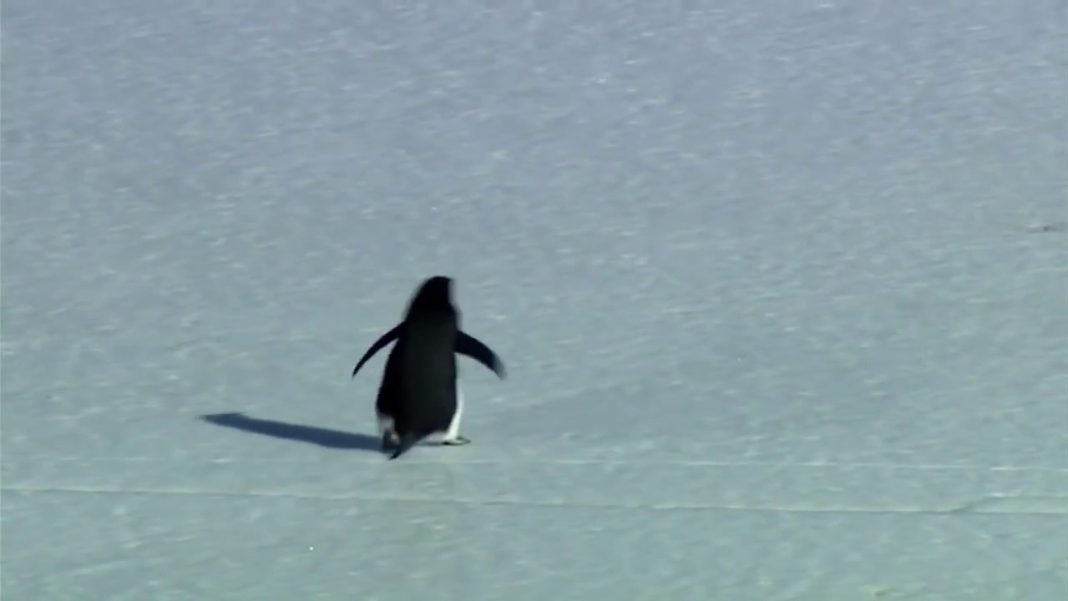

A single penguin breaks away from its group and starts walking in the opposite direction—away from the sea, away from safety, and toward an icy mountain. There is no obvious panic, no dramatic reaction. Just quiet determination. That brief moment, captured in nature footage and later pulled into internet culture, became what the online world now calls the “Nihilist Penguin.”
At first glance, it seems insignificant. But in early 2026, this small clip evolved into one of the most powerful and unexpected symbols of the internet’s emotional and political climate. What began as a darkly humorous meme about existential exhaustion soon transformed into a cultural marker—and eventually, a political tool.
The origins of the meme lie in documentary footage often associated with filmmaker Werner Herzog’s work in Antarctica. The penguin shown walking away from its colony is widely understood online as an example of an animal straying from instinctual survival. In nature, such behavior is usually fatal. On the internet, however, that act of quiet departure took on symbolic meaning. The penguin wasn’t portrayed as confused or frightened—it looked resolute. That distinction mattered.
As the clip circulated years ago on forums and niche communities, it became shorthand for a certain emotional state: walking away without explanation, rejecting the expected path, choosing detachment over struggle. It wasn’t loud rebellion. It was silent refusal.
When the meme resurfaced in 2026, it did so in a very different internet environment. Platforms were saturated with short-form video, remix culture, and emotionally coded content. People were exhausted—socially, economically, politically. The penguin’s calm march away from everything felt uncomfortably relatable. Users began pairing the clip with captions about quitting jobs, leaving relationships, abandoning social media, or mentally checking out of a world that felt overwhelming. The meme spread rapidly because it didn’t demand interpretation. People simply felt it.
What made the “Nihilist Penguin” especially powerful was its ambiguity. It did not clearly stand for hope or despair. It could be read as surrender or as freedom. That flexibility made it perfect for reinterpretation—and eventually, appropriation.
As with many viral symbols, politics soon followed.
Online political culture has increasingly relied on memes to communicate complex ideas quickly, emotionally, and with plausible deniability. Memes allow political actors to signal identity, provoke reactions, and dominate attention without formal statements. The penguin, already loaded with emotional meaning but no fixed ideology, became an ideal vessel.
The turning point came when the meme was used in a political context connected to Donald Trump and the White House. An AI-styled image featuring Trump alongside the penguin appeared online, accompanied by the phrase “embrace the penguin.” The post was widely interpreted as part of broader messaging related to Greenland and geopolitical positioning. Whether it was meant as irony, provocation, or strategic meme usage, the effect was immediate.
The internet reacted with confusion, mockery, and counter-memes. Users questioned the meaning, fact-checked the implications, and flooded platforms with parodies. What was once a symbol of quiet existential withdrawal had been pulled into the machinery of political messaging.
On the surface, the move appeared to backfire. Many users ridiculed the attempt, accusing it of misunderstanding the meme or cheapening its meaning. But in the logic of modern attention economics, backlash is still visibility. The image circulated widely, was discussed across platforms, and introduced the meme to audiences who had never seen it before. In that sense, the transformation was complete: the penguin had crossed from internet culture into political symbolism.
This shift illustrates how memes now function in public discourse. They are no longer just jokes or expressions of mood. They are contested symbols—open to interpretation, manipulation, and strategic use. Once a meme reaches a certain scale, it stops belonging to its original creators and becomes a shared cultural resource, one that anyone with enough reach can attempt to claim.
The “Nihilist Penguin” followed this exact path. It began as a piece of nature footage, became a metaphor for burnout and detachment, and was eventually absorbed into political communication. Its meaning did not disappear; it multiplied. Some still see it as a personal symbol of opting out. Others now associate it with irony-laced political messaging. Both readings coexist, layered on top of each other.
What this episode ultimately reveals is not just how fast memes travel, but how deeply they now intersect with power. Online culture has reached a point where emotional symbols move faster than policy explanations, and images can shape narratives more effectively than speeches. The penguin’s walk toward the mountain is compelling precisely because it resists explanation. It invites projection.
And that is why it worked.
In 2026, the “Nihilist Penguin” is no longer just a meme. It is a snapshot of an era—one defined by exhaustion, irony, and the blurring of lines between culture, emotion, and politics. A small animal walking away became a mirror for millions of people, and then a tool in a much larger conversation.
The penguin never turns back. And neither does the internet.
Related posts:
 The Ultimate Guide to Meme Marketing: How Brands Go Viral for Free
 From Meme to Movement: How the ‘Blue Sweater Kid’ Meme Inspired a Global Climate Campaign
 Grimace Shake Meme: How a McDonald’s Milkshake Became a Viral Sensation
 Why Everyone is Talking About the “Library Whisperer” Video—A Deep Dive