
Artificial intelligence and machine learning have moved from experimental technologies into production systems that power real products, decisions, and services. Recommendation engines, fraud detection systems, computer vision platforms, natural language models, and predictive analytics now operate at scales that demand extraordinary computing power.
As these workloads mature, a clear pattern has emerged: serious AI and machine learning systems gravitate toward bare metal servers. This preference is not driven by tradition or conservatism, but by the technical realities of how AI workloads behave under load and at scale.
AI Workloads Are Fundamentally Different
Unlike conventional web applications, AI and machine learning workloads are computationally intense, data-hungry, and often long-running. Training a model may involve processing terabytes of data over days or weeks, while inference systems must deliver results in milliseconds with absolute consistency.
These workloads stress every layer of infrastructure simultaneously. CPUs, GPUs, memory bandwidth, storage throughput, and network performance all become limiting factors. Even small inefficiencies introduced by abstraction layers can compound into significant performance penalties.
Virtualized environments are optimized for flexibility and multi-tenancy. AI workloads, by contrast, prioritize raw, uninterrupted access to hardware. This mismatch is one of the primary reasons bare metal servers remain the preferred foundation for serious machine learning systems.
Performance Without the Virtualization Penalty
Virtualization introduces overhead. While this overhead is acceptable for many applications, it becomes problematic for AI workloads that depend on maximum hardware utilization. GPU-bound tasks, in particular, are highly sensitive to latency, memory access patterns, and driver-level optimizations.
Bare metal servers eliminate the hypervisor layer, allowing AI frameworks to interact directly with the underlying hardware. This direct access translates into higher throughput, lower latency, and more predictable performance during both training and inference.
For organizations running large-scale training jobs or latency-sensitive inference systems, the difference is measurable. Faster training cycles mean quicker iteration and deployment. More efficient inference means better user experience and lower operational cost per request.
Full Control Over GPU and Accelerator Configuration
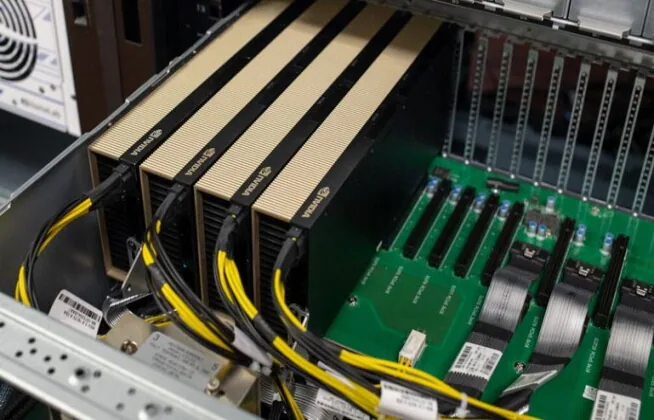
Modern AI workloads rely heavily on specialized hardware such as GPUs, TPUs, and other accelerators. The effectiveness of these components depends not only on their raw capabilities, but on how they are configured, cooled, and interconnected.
Bare metal environments provide full control over hardware selection and layout. Organizations can choose specific GPU models, optimize PCIe configurations, and tune system-level parameters to match their workload characteristics. This level of customization is difficult, and sometimes impossible, to achieve in shared or abstracted environments.
For machine learning teams pushing models to their limits, this control enables optimizations that directly impact training speed, inference latency, and overall system efficiency.
Predictable Performance for Long-Running Jobs
AI training jobs are often long-running and resource-intensive. Interruptions, throttling, or performance variability can waste hours or days of computation. In shared environments, resource contention or platform-level scheduling decisions can introduce unpredictability that disrupts these workflows.
Bare metal servers provide performance isolation. Resources are dedicated exclusively to a single workload, ensuring consistent behavior throughout the training lifecycle. This predictability is especially valuable for research teams, production pipelines, and time-sensitive deployments where delays carry significant cost.
From an operational perspective, predictable performance simplifies planning and reduces the risk of failed or incomplete training runs.
Data Gravity and High-Throughput Storage
AI systems do not only require compute power; they require fast, sustained access to large datasets. Moving data repeatedly between remote storage and compute nodes introduces latency and bandwidth constraints that slow down training and inference.
Bare metal servers support high-performance local storage architectures, such as NVMe-based arrays, that deliver the throughput required for data-intensive workloads. By colocating compute and data, organizations reduce data transfer overhead and improve overall pipeline efficiency.
This concept of data gravity becomes increasingly important as datasets grow. Once data reaches a certain scale, it becomes more efficient to bring computation to the data rather than moving data across networks.
Network Performance for Distributed Training
Many modern AI models are trained across multiple nodes using distributed frameworks. In these scenarios, network latency and bandwidth play a critical role in overall performance. Synchronization delays between nodes can significantly slow training if the network becomes a bottleneck.
Bare metal environments allow organizations to deploy high-speed, low-latency networking configurations optimized for distributed workloads. This capability ensures that scaling out across multiple servers delivers real performance gains rather than diminishing returns.
Such configurations are particularly valuable for deep learning workloads that rely on frequent parameter updates and inter-node communication.
Security, IP Protection, and Isolation
AI models and datasets often represent significant intellectual property. For organizations operating in competitive or regulated environments, protecting this IP is a strategic priority.
Bare metal servers provide physical isolation, reducing exposure to risks associated with multi-tenant platforms. This isolation simplifies security architecture and helps organizations meet internal governance requirements and external compliance standards.
For enterprises and research institutions alike, this level of control supports both security assurance and audit readiness.
Cost Efficiency at Sustained Scale
While cloud-based GPU instances offer flexibility, their cost structure can become prohibitive for sustained AI workloads. Long-running training jobs and constant inference traffic can result in high, variable expenses that are difficult to predict.
Bare metal servers offer a different economic model. Fixed-cost infrastructure combined with high utilization often results in lower cost per training run or inference request over time. This predictability supports better financial planning and makes large-scale AI initiatives more sustainable.
As AI systems move from experimentation into core business operations, this cost efficiency becomes increasingly important.
Why Infrastructure Providers Matter
Not all bare metal environments are equal. AI workloads demand more than just access to hardware; they require stable power, advanced cooling, high-speed networking, and operational expertise. Providers experienced in high-performance and regulated workloads, such as Atlantic.Net, design their infrastructure to support these demanding use cases reliably.
Such providers bridge the gap between raw hardware and production-ready platforms, enabling organizations to focus on model development rather than infrastructure limitations.
Conclusion
AI and machine learning workloads expose the limits of generalized infrastructure. Their appetite for compute, data throughput, and predictable performance makes bare metal servers not a legacy choice, but a strategic one.
By offering direct hardware access, performance isolation, and architectural control, bare metal environments align closely with the realities of modern AI systems. As artificial intelligence becomes more deeply embedded in critical applications, the infrastructure supporting it must deliver not only flexibility, but certainty.
For organizations serious about AI at scale, bare metal servers provide the foundation required to train faster, infer smarter, and operate with confidence in an increasingly data-driven world.